Wednesday, 15 May 2013

What Is a Determiner?

IMG: Source
 
Among lists of parts of speech, you may see an unfamiliar word among nouns, verbs, conjunctions, and the other usual suspects. What’s a determiner?

A determiner is a word that modifies a noun or a noun phrase. That’s also the definition of adjective, but although both parts of speech modify nouns, determiners are distinct from adjectives in several respects, most obviously in that the latter express attributes, whereas determiners express relationship. (These categories also differ in that although the inventory of adjectives is innumerable, most types of determiners include a finite number of words.)

The categories of determiners include the following:

§ articles (a, an, and the)
§ possessive nouns (for example, John’s, wife’s in “my wife’s,” and doctor’s in “the doctor’s”)
§ possessive pronouns (such as hers and mine)
§ indefinite pronouns (like each, either, all, and fewer)
§ demonstrative pronouns (this, that, these, those, and such)
§ numbers (five, “a hundred,” and so on)

There are only three articles and five demonstrative pronouns, and the number of possessive and indefinite pronouns is also limited; only possessive nouns and numbers are limitless, but they are included with other determiners because their function is similar to that of the other types.

Note, however, that possessive nouns, by their very nature, require assistance from one of the other types of determiners. For example, some require an article (“the missile’s trajectory”), some need a pronoun (such as the possessive pronoun our, as in “our house’s address sign”), and some are accompanied by a number (“three players’ uniforms”).

Two similar classes of words are quantifiers and predeterminers. A quantifier, as the name signifies, expresses how much or how many of something exists or exist. This type, sometimes considered another variety of determiner and sometimes placed in its own category, consists of words and phrases that indicate quantity, such as few, all, or “a couple of”; numbers are sometimes classed with these general quantifiers. (Quantifiers can be combined with other determiners, such as in “their many detractors” or “all the bottles.”)

Some quantifiers work with count nouns but not with mass, or noncount, nouns (“many horses,” but not “many water”); others are used only with mass nouns (“little water,” but not, in the context of quantity rather than size, “little horses”). Others are suitable for both count and mass nouns (“some horses,” “some water”). 

Predeterminers, as the name indicates, refers to words that precede determiners. These include multipliers and fractions (for example, twice and one-half, or just half, in “twice my size” and “one-half of his fortune”) and intensifiers (for example, quite and rather in “quite the scholar” and “rather more people than I expected”).

10 Functions of the Comma

IMG: Source
A comma is a versatile punctuation mark, serving ten basic functions. Here’s an enumeration, with examples.

1. Separate the elements in a series: “Groucho, Harpo, and Chico developed the philosophy called Marxism.”

Many periodicals and websites, and most colloquially written books, omit the serial, or final, comma, but it is all but mandatory in formal writing and is recommended in all usage. As language maven Bryan Garner observes, “Omitting the serial comma may cause ambiguities, whereas including it never will.”

2. Separate coordinated independent clauses: “I like the Marx Brothers, but she thinks they’re too silly.” (An independent clause is one that can stand on its own as a sentence but is linked with another by a conjunction and/or a punctuation mark.)

Exceptions include sentences with closely linked clauses (“Go to the window and see who’s there”) and those with a compound predicate (“The Marx Brothers are known for their puns and their sight gags”).

3. Separate an introductory word (“Naturally, I agree with you”), phrase (“Last summer, I went on a long vacation”), or subordinate clause (“If you’re too busy now, wait until later”) from the remainder of the sentence.

4. Separate an optional parenthetical element from the remainder of the sentence. “We have, in a manner of speaking, won despite our loss.” (The phrase “in a manner of speaking” could also be set off by em dashes or parentheses, depending on whether the writer wishes to emphasize the interruption of the statement “We have won despite our loss” or wants to diminish it as an aside.)

5. Separate coordinate adjectives from each other: “I could really use a tall, cool drink right now.” (Do not separate noncoordinate adjectives with a comma.)

6. Separate an attribution from a direct quotation: “She said, ‘Neither choice is very appealing’”; “‘That’s not my problem,’ he replied.” (A colon may be precede a formal pronouncement or an attribution that forms a complete thought, as in, “He had this to say: ‘Her point is irrelevant.” Omit punctuation when the attribution is implied, as in “Your response ‘Her point is irrelevant’ is evasive.”)

7. Separate a participial phrase or one lacking a verb from the remainder of the sentence: “Having said that, I still have my doubts”; “The deed done, we retreated to our hideout.”

8. Separate a salutation from a letter (“Dear friends,”) or a complimentary close from a signature in a letter (“Sincerely,”). A colon should be used in place of a comma in a formal salutation.

9. Separate elements when setting off a term for a larger geopolitical entity from that for a smaller one located within it (“Santa Barbara, California, is located on the coast”) and for elements of street addresses (“1600 Pennsylvania Avenue, Washington, DC”) (and dates (“January 1, 2013”).

10. Separate groups of three digits in numbers: (Let me tell you how to make your first 100,000,000 dollars.” (Because large numbers are difficult to scan, it’s usually better to use one of the following forms: “100 million dollars,” “one hundred million dollars.”)


Wednesday, 8 May 2013

10 Tips About How to Write a Caption

IMG: Source
If you contribute to production of a print or online publication that includes photographs or illustrations, you’re likely, at some point, to write captions. Here’s some advice about how to write good ones.

1. Caption copy must match the tone of the running text (the general written content, as opposed to display type such as headlines and captions). Determine whether captions should be formal or informal, or serious or humorous, or whether the tone can vary depending on circumstances.

2. Caption format will depend on various factors. Portraits (often referred to as headshots), or images of places or products can simply be captioned with a name: “John Smith,” for example, or “Deluxe Dual-Purpose Widget,” without terminal punctuation. (If the product caption is a description rather than an official product name, capitalize only the first word and proper names.)

Captions for photos or other images showing events or occurrences can consist of incomplete sentences (“Taking the Inchworm personal-transportation device for a test drive”), but it’s generally better to use one or more complete sentences. (“John Smith takes the Inchworm personal-transportation device for a test drive.”) Avoid eliding words, as in “John Smith takes Inchworm personal-transportation device for test drive”; write the caption as if you were speaking it aloud, not as if you were writing a headline or dictating a telegram.

Some publications use a lead-in phrase to establish the caption; these are either straightforward or may be conceptual and might be humorous and/or alliterative as well. They are often formatted in boldface and followed by a colon, and they generally are capitalized like headlines. (“Wiggle Wagon: John Smith takes the Inchworm personal-transportation device for a test drive.”)

3. A brief article can be formatted as a caption; it’s best to distinguish such special features with a box around the photo and caption and/or a different font treatment. (A headline is optional.) The extent of the block of type shouldn’t be less than the space taken up by the photo, and the caption should be broken up into paragraphs if it’s more than a few lines long, and perhaps divided into columns if the image is more than one column wide.

4. Use context to determine how thoroughly to identify photographic subjects. Because a person, place, or thing shown in a photo is almost invariably identified in accompanying running text, titles, affiliations, and other additional information, for example, are rarely required in captions. Subsequent photos of the same subject can be simplified (as when a person’s full name is used only in the first of several captions for photos featuring that person).

5. Avoid replicating content from the running text in a caption. The caption should allude to the running text’s topic, but the specific wording should at most paraphrase the running text.

6. Captions should not use judgmental or facetious language or make assumptions about, for example, a subject’s state of mind. (Of course, a publication that features humorous or satirical content is an exception.)

7. If more than one person is featured in the photo, use directional or other targeting terms (for example, “left,” “standing,” or “holding aardvark”) only if the distinction between the photo’s subjects is not obvious. If you must use such wording, be consistent about style and format. Here are some alternatives (the first of which trusts readers to assume left-to-right orientation):

“Security guards Winken, Blinken, and Nod stand watch.”
“Security guards Winken (left), Blinken, and Nod stand watch.”
“Security guards Winken, left, Blinken, and Nod stand watch.”
“Security guards (from left) Winken, Blinken, and Nod stand watch.”
“Security guards (left to right) Winken, Blinken, and Nod stand watch.”

8. Avoid tired terminology. If, in a photo accompanying an article about a cash donation, a person is pictured pointing at an oversized mockup of a check, don’t write, “Charity Goodheart gestures at a giant check as Greedco chairman Rich Moneybags looks on.” (And ask yourself why your company or organization is publishing such a tired visual cliché in the first place.) Simply write, “Charity Goodheart acknowledges a donation from Greedco chairman Rich Moneybags.”

9. Fact-check all quantitative information such as spelling, names (of people, places, and things) and titles, and data, and double-check that you describe action or procedures accurately.

10. Don’t forget to include credits, and be consistent in style and format. Acknowledge the photographer or stock-photography source with the name alone; there’s no need to write “photo by” or the like. (However, if a photo is provided without charge by another source, credit, for example, “Courtesy Lookatthis.com.”) Distinguish the credit from the caption by using another font or point size and/or placing it vertically along the right-hand edge of the image.

Use a Dash for Number Ranges

IMG: Source

Which symbol should be used with numbers: a hyphen (-), or an en dash (–)? The question may seem trivial — a dash is a dash, right? — but using the correct symbol aids comprehension, just as commas and semicolons signal distinct grammatical structures, and no one will argue that those two punctuation marks can be used interchangeably.

Hyphens are used to separate groups of numbers, such as in telephone numbers or numbers of financial accounts. But for almost all other cases, the correct punctuation mark is an en dash, which indicates a range or a difference.

A span of years (such as “2009–2012”) or any other time range includes an en dash. (And note that “from 2009–2012” and “between 2009–2012” are incorrect; either use both from and to, or between and and, or neither.) The same treatment is given to a sequence of components, such as a range of chapter or page numbers or amounts (for example, “chapters 1–10” or “250–300 pages”).

A range of monetary amounts — and any other amounts — is also represented this way, as in “Salary range: $75,000–$80,000.” (Note that when expressing a range with very large numbers, to avoid confusion, the first number should not be abbreviated; for example, “$75–$80,000” means “from $75 to $80,000,” not “from $75,000 to $80,000.”)

Two contexts that cause confusion about which dash to use are scores and votes. These are not, technically, ranges, because nothing exists between them, as in the case of “2009–2012,” in which that time span includes 2010 and 2011 as well, and of “chapters 1–10,” which also includes every page between 1 and 10. But The Chicago Manual of Style, reasoning that the symbol between the numbers represents a difference between two values (and that the symbol is pronounced to), has elected to use en dashes for both types of representation.

Therefore, use an en dash to indicate scores for sports or other competitions (for example, “Her team won 6–3” or “They came back from behind to chalk up a 97–92 victory”). Note, however, that when a score does not immediately follow a verb or precede a noun, as in the examples above, it should be set off from the rest of the sentence by one or two commas: “East prevailed over West, 97–92”; “East prevailed over West, 97–92, for the league championship.” Win-loss records should also be formatted with an en dash: “The team went on to earn an 8–4 record.”

Votes are treated the same way: “The city council approved the project with a 5–2 vote.”

Many newspapers and websites follow the style recommended by the Associated Press Stylebook, which is to simply use a hyphen in place of an en dash. That preference presumably dates from the lead-type era, when compositors didn’t want to be bothered about trying to distinguish a – from a – on a piece of metal the size of a watermelon seed. Last time I noticed, however, producing an en dash was a simpler task. Dare to dash.

Are Tense Shifts Advisable?

IMG: Source

Should all verbs in a sentence be consistent in tense? Tense shift is often essential, but it’s sometimes unnecessarily discouraged.

See, for example, this sentence: “I thought I’d seen the last of him, but here he comes again.” The shift in tense is natural; to revise the beginning to “I thought I’ve seen . . . or “I think I’ve seen . . .” or “I thought I saw . . .” is not necessary (though they’re all defensible), but I think the original is the best choice.

A reader recently alerted me to a questionable assertion about this topic in a writing handbook. In an otherwise sensible passage advising against unnecessary shifts in tense, the guide took exception to this passage:

“Naming the five best movies of last year was easy. Ninety percent of the movies I see are lousy, and that leaves only a handful that are even worth considering.”

The recommended revision follows:

“Naming the five best movies of last year was easy. Ninety percent of the movies I saw were lousy, and that left only a handful that were even worth considering.”

I disagree with that solution. The second sentence, I think, is perfectly acceptable as is: The first sentence establishes that an action was taken in the past. The second one shifts to make a related observation that is true now, at the moment the statement is written and at the moment when it is read. No cognitive dissonance occurs.

Past tense can, alternatively, be introduced into the passage, but not to the extent shown in the handbook’s revision. Here’s the compromise alteration:

“Naming the five best movies of last year was easy. Ninety percent of the movies I saw are lousy, and that left only a handful that are even worth considering.”

This version retains the backward glance at the creation of the list but suggests that the writer’s evaluation about the quality of films is perpetual; the ninety percent of films he or she saw are lousy and, to the reviewer, will always be lousy, and only a handful are and will be worthy of consideration.

Here’s another example:

“He said it made sense for his clients to self-publish through the agency instead of going directly to Amazon themselves, because the agency brought experience in marketing and jacket design.”

What the person found sensible is presumably something that is and will always be sensible, so the stated strategy “makes sense,” not “made sense”; the latter phrase implies that the strategy was sensible at one time but may no longer be so. This introduces an ambiguity of comprehension.

Similarly, the agency’s experience in marketing and jacket design is presumably a steady state, so the final clause should include the phrase “brings experience.” The point is not that, at one time, the agency provided an advantage; it is that the agency continuously provides the advantage.

Hence my recommended revision:

“He said it makes sense for his clients to self-publish through the agency instead of going directly to Amazon themselves, because the agency brings experience in marketing and jacket design.”

Friday, 3 May 2013

5 Examples of Proper Style for Proper Nouns

IMG: Source
A proper noun, also known as a proper name, is capitalized to indicate that it denotes a unique entity or phenomenon. Many entities or phenomena are widely known by their names. Sometimes, however, writers misunderstand or misrepresent the label. Here are five examples of proper nouns that illustrate the importance of verifying precise nomenclature and considering the context in which it is used.

1. Big Ben
This is the official nickname, specifically, of the bell in the Elizabeth Tower, the iconic structure often used as a visual shortcut to identifying London in photographs, on television, and in films. (The tower, previously called simply the Clock Tower, was renamed in 2012 in honor of the sixtieth anniversary of Queen Elizabeth II’s reign.) However, popularly, the phrase generally refers to the clock in the tower or the tower itself.

2. Centers for Disease Control and Prevention
This US government agency’s official name is the Centers for Disease Control and Prevention, but it retains the initials, CDC, of its previous designation, the Centers for Disease Control; note that the first word is plural. (A similar example is the name of the National Institutes — not Institute — of Health.)

3. Halley’s Comet
The technical name for this peanut-shaped orbiting body roughly the size of a big-league Himalayan mountain is Comet Halley. (actually, 1P/Halley is its astronomy-catalog designation.) Because of its relative familiarity, however, due to unusually frequent reappearances (roughly every seventy-five years), it is also called Halley’s Comet.

The traditional pronunciation among astronomers rhymes with alley, but, perhaps as a result of contamination from the name of the seminal rock-and-roll band Bill Haley and the Comets, most laypeople pronounce it to rhyme with daily. (No one knows how discoverer Edmund Halley pronounced his name, but I’d give the odds to the stargazers’ convention.)

4. New York
The largest US city is popularly called New York (the official name is “the City of New York”), but writers should determine whether, depending on the context, it should be referred to as New York City to distinguish it from New York State. (In this designation, and in “Washington State” — so as not to confuse the state with Washington, DC — state is capitalized even though it’s not part of the state’s official name.)

5. Sierra Nevada
The name of the mountain range forming the backbone of California — a name shared by several other ranges throughout the world — from the Spanish phrase meaning “snowy mountains,” should not be pluralized with the letter s, and “the Sierra Nevada Mountains” is partially redundant. (The same is true of the truncation “the Sierras”; call it “the Sierra.”)

Many other geographical designations are redundant: Fujiyama translates as “Mount Fuji”; the words sahara, gobi, and negev all mean “desert”; and the first word in “Rio Grande,” as well as Avon and Don — the names for rivers in England and Russia, respectively — means “river.” Although it’s not wrong to use the word mount, desert, or river before or after the name of a geographic feature that means “mountain,” “desert,” or “river,” the common noun can often safely be omitted (for example, “Fujiyama,” “the Sahara,” and “the Rio Grande”). Note, too, that river, when it precedes a river’s name (for example, “the river Nile”), is always descriptive and not part of the name.

Thursday, 2 May 2013

“Size” Matters

IMG: Source

How do you treat the word size (or is it sized?) when it’s used in combination with other words as an adjective? Here’s a rundown of the options, with judgments about the best bets.

The combination of mid with size is treated in various combinations: as midsize, mid-size, midsized, and mid-sized. The most prevalent form, logically — following the tendency to omit hyphens after prefixes and because omitting the second d is simpler than retaining it — is midsize. Medium-sized, however, prevails over medium-size; the hyphen is to be expected, because medium is an entire word, not just a prefix, like mid, but the retention of the final d is puzzling.

Midsize is the adjective of choice for vehicles, while medium-sized is much more likely to apply not only to entities such as businesses and organizations but also to most other products and objects.

And how should references to comparatively small or large phenomena be styled? Some people would follow the pattern by writing small-size or small-sized, or large-size or large-sized, but -size or -sized is redundant because small and large provide a frame of reference to the quality being discussed, whereas medium is vague enough to require the contextual clue of -sized, even when small and/or large are also employed in the passage. (A range should be rendered as follows: “Small to midsize cars were tested” or “The survey applied to small to medium-sized businesses.”)

Words for bed sizes are expressed as, for example, king-size or king-sized. Merriam-Webster’s Collegiate Dictionary, probably the most widely consulted dictionary in the publishing industry, notes that king-size is prevalent, which is consistent with its entries for similarly constructed words, include bite-size, legal-size, life-size, man-size, plus-size, pocket-size, in which the -sized form is regarded as a variant.

Similar terms, such as those in the sentences as “We watched a car-size boulder tumbling down the slope” or “A house-size depression appeared in the field,” can be created as needed. However, writers should take care in producing such constructions with less common references. “He approached the brick-size object as it hovered in front of him” is reasonable, because although bricks vary in size, most readers will probably think of the typical red clay building material. But “a dog-size creature” is vague because of the disparity of size among dog breeds, and “a cell phone–size device” may seem awkwardly constructed. (Try “a device the size of a cell phone” instead.)

Wednesday, 1 May 2013

Answers to Questions About Apostrophes

IMG: Source
Here are three questions from readers about use of apostrophes to mark possession or plurality, followed by my responses.

1. When I have a list of people who all possess something, how do I handle the apostrophe(s)? Which of the following sentences is correct?:

“Today is John, Mary, and my second anniversary with the company.”

“Today is John’s, Mary’s, and my second anniversary with the company.”

“Today is John, Mary’s, and my second anniversary with the company.”


“Today is John’s, Mary’s, and my second anniversary with the company” is correct, because the possessive (or, more accurately, genitive) function of my covers only itself, and each of the names needs its own possessive markers — they can’t share one. (Even “Today is John and Mary’s second anniversary with the company” works only if they joined as a single unit; by contrast, “Today is John and Mary’s second wedding anniversary” is correct because it implies that they united as a couple.)

2. Which of the following options regarding the apostrophe s is correct?:

“This view of Smith regarding the relation between rationality and social contexts is inspired by Marx’s philosophy.”

“This view of Smith’s regarding the relation between rationality and social contexts is inspired by Marx’s philosophy.”


The apostrophe plus s is correct: This is an example of the possessive, or genitive, case; the view “belongs” to Smith, so it should be treated as if you wrote “Smith’s view . . . .” (One could also write, “This view from Smith . . .,” but the possessive form reads better.)

3. Recently, there was a headline in the Los Angeles Times that read, “The what if’s of Iraq.” Is the apostrophe in if’s correct?

No. It should read, “The what ifs of Iraq” (or, better yet, what-ifs), just as one would refer to more than one no as nos (not no’s) and a list of recommendations as “dos and don’ts” (not don’t’s). The editors probably thought that “what ifs” looks odd, but they violated the rule “Minimize exceptions”: They wouldn’t (one hopes) insert a second apostrophe in don’ts, so why put an extraneous one in “what ifs”?

Tuesday, 30 April 2013

Terms for the Seasons of the Year

IMG: Source
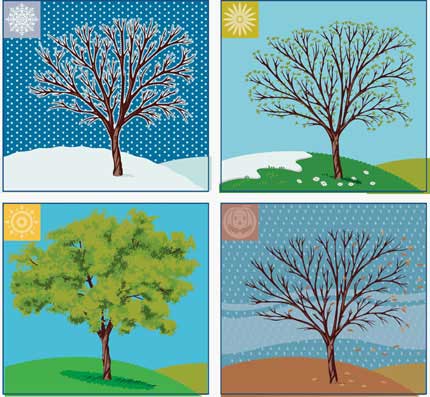
Words for the seasons and related terms often have both literal and figurative connotations. Here are the words and their various senses.

Spring (from the Old English word springan, akin to the same word in Old High German, which means “to jump”) has a sense of freshness and growth. The word is sometimes used to refer to a sociopolitical movement for greater freedom and tolerance, as in phrases like “Prague Spring” and, more recently, “Arab Spring.”

Spring itself, in these senses, has no direct adjectival form besides springlike; springy refers to the word’s sense of movement. However, vernal (from the Latin word ver, meaning “spring”) is suitable for references to anything pertaining to the spring, or anything fresh, new, or youthful. In a practical sense, it often refers to phenomena unique to springtime, such as a vernal pool, a body of water that dries up as summer encroaches on spring.

Summer (from the Old English word somer) has associations with thriving and mature growth, and it is also a poetic synonym for years in references to one’s age (for example, “in my tenth summer,” “a boy of fifteen summers”). Summery is a prosaic descriptor term describing qualities associated with summer. Estival (from Latin aestivus, meaning “of summer”) also means “pertaining to summer”; estivation is the summertime equivalent of hibernation, or sojourning at one location all summer.

Autumn (ultimately from the Latin word autumnus), interchangeable in literal meaning with fall, has a figurative sense pertaining to full maturity or the onset of decline, as does the adjective autumnal. Winter has associations with decay and inactivity, and wintry, besides its literal sense, refers to being weathered as a result of winter weather or as if by such conditions, or to being aged; it also suggests a cold attitude or response.

Solstice (ultimately from the Latin word solstitium, meaning, literally “sun standing”) and equinox (from the Latin term aequinoctium, a combination of the terms for “equal” and “night”) refer to the times of the year when, respectively, daylight is shortest and day and night are of equal length.

The adjective equinoctial (or equinoctal) refers literally to the first day of spring and fall and has no established figurative meaning. (The first variant is also used as a noun synonymous with equator or referring to a storm during the equinoctial period.) There is no adjectival form of solstice, which corresponds to the onset of summer and winter.

4 Types of Gerunds and Gerund Phrases

IMG: Source

A gerund is one of three classes of words called verbals — words based on verbs and expressing an action or a state of being but serving another grammatical function. (The other two are participles and infinitives.) A gerund, which functions as a noun, can consist of a single word or a phrase.

The four types of gerunds and gerund phrases follow:

1. Subject
Gardening is my favorite hobby. (Gardening is normally a verb, but here it is the name of an activity.)

Gardening in the summertime is a challenge because of the heat. (The gerund is followed by a modifying adverbial phrase, forming a gerund phrase.)

2. Direct Object
My neighbors admire my gardening. (The admiration is not for the action of gardening, but for the results of the action.)

I am enjoying my gardening this year. (The direct object of the subject is “my gardening this year.”)

3. Object of Preposition
I have received several awards for my gardening. (The awards have been given for the results of the activity.)

Some people consider my interest in gardening an obsession. (The gerund phrase is “gardening an obsession.”)

4. Subject Complement
My favorite hobby is gardening. (Again, gardening is described as something done, not the act of doing it. The statement is the inverse of the first sentence in this group; here “My favorite hobby” is the subject, and gardening is its complement.)

I do my gardening in the morning. (The phrase “gardening in the morning” is the subject complement.)

Confusion with Present Participle Phrases
If a sentence resembling one of these statements includes a comma, it’s likely to contain a present participle phrase, not a gerund phrase. For example, the sentence “Gardening in the summertime, I built up a resistance to hot weather” contains a present participle phrase, which includes a participle, a verb functioning as an adjective or an adverb.

Friday, 26 April 2013

Answers to Questions About Usage

IMG: Source
Many writers — native English speakers and nonnative speakers alike — are confounded by uncertainty or confusion about usage, the complicated issue of what, exactly, a given word means regardless of its practical or official definition. 

1. One of the words I hear all the time, which I believe is improperly used, is hopefully, as in “Hopefully, we’ll be successful.” I’d love to hear your thoughts about using this word — hopefully, you’ll agree with me.

For better or worse, in the usage you abhor, hopefully is firmly established, and employment in its original sense (“in a hopeful manner,” as in “I waited hopefully for her response”) has all but disappeared. The only thing one can do to curtail its use is avoid using it oneself, but this is a case in which the people have spoken: The new sense will prevail.

2. For the past few years, I’ve been noticing the use of “only ever,” as in “I only ever stay on the weekends.” Isn’t ever unnecessary and perhaps incorrect?

Yes, ever is an extraneous intensifier. It’s not incorrect, but it should be avoided in formal writing.

3. May “Thank you for correcting me” sound ironic in Modern English? I once used it and got negative feedback. And I think it has pejorative connotation in English, though in my mother tongue it’s just a way to express gratitude or thanks.

Yes, “Thank you for correcting me” looks perfectly neutral, but it’s not: In English, the notion of correcting someone has a negative connotation, like being criticized or scolded, and someone who receives that comment from you may assume that you’re resentful for the assistance.

Depending on the situation, it would be better to say or write, “Thank you for providing me with the correct information” (less concise, but neutral in tone) or “Thank you for clarifying that for me.” In American English, at least, an informal, friendly way to acknowledge correction is “Thanks for setting me straight.”

Thursday, 25 April 2013

7 Cases for Inserting or Omitting Commas

IMG: Source
Here are discussions of seven types of situations in which the presence or absence of a comma depends on various factors.

1. Word Function

Whether a comma follows a word sometimes depends on the function of the word. For example, when now is employed at the head of a sentence to refer to the present time, there’s no reason to separate it from the rest of the statement: “Now you know.”

But when now serves as an interjection to mark a transition or attract someone’s attention, it should be set off: “Now, have you had dinner?” (That same series of words could be used in a temporal sense, though: “Now have you had dinner?” suggests that the writer is impatient with the person the question is directed to.)

2. Before Because

A sentence such as “I didn’t want to go because I hadn’t enjoyed myself last time” implies that the writer is explaining that the lack of enjoyment isn’t a factor in reluctance to attend an event; the reason for the reluctance will presumably follow.

But if the meaning is opposite — if the lack of enjoyment is the reason for the reluctance to attend — a comma should precede because to signal that what follows the comma is a dependent clause: “I didn’t want to go, because I hadn’t enjoyed myself last time” Alternatively, the dependent clause can begin the sentence: “Because I hadn’t enjoyed myself last time, I didn’t want to go.”

3. Apposition

An appositive is a word or phrase equivalent in meaning to an adjacent word or phrase, as in “She wrote to her brother, John”; “her brother” and “John” mean the same thing, so they are appositives, and the comma is necessary to set it off. However, if the woman has more than one brother, write “She wrote to her brother John.”

Similarly, in “I met the writer, Jane Doe,” the comma is correct only if the writer has been alluded to before without mention of her name. Otherwise, the comma between the appositives suggests that only one writer exists. (And that puts me out of a job.) Even if writer is modified, the meaning differs: “I met the mystery writer, Jane Doe” suggests a previous reference to two or more writers, only one of whom writes mysteries, whereas “I met the mystery writer Jane Doe” simply specifies the genre in which Jane Doe writes.

4. Relative Clauses

Commas may or may not be necessary, depending on whether each statement in an otherwise identical pair of sentences uses the word that or which: In “The house that Jack built is falling apart,” the phrase “that Jack built” is essential to the sentence, which specifies a particular house. In “The house, which Jack built, is falling apart,” the emphasis is on what is happening to the house, and the identity of the builder is a parenthetical, so the optional information should be bracketed by commas.

“The house which Jack built is falling apart,” without commas, is also correct; it is identical in meaning to “The house that Jack built is falling apart.” However, the convention in American English is to avoid using which in this sense to prevent confusion with the meaning of the sentence with the parenthetical phrase.

5. Short Introductory Phrases

Many people choose to omit a comma after introductory phrases of just a few words, as in “During the summer I like to travel.” However, such omission is arbitrary when such sentences are compared to those with longer introductory phrases — and wrong in the case of transitional tags like finally, furthermore, and unfortunately — and for the sake of consistency, a comma should follow any introductory word or phrase.

6. Short Independent Clauses

In brief sentences such as “I will sort and you can staple” that consist of two independent clauses (complete thoughts that could stand on their own as distinct sentences), writers often choose to omit the otherwise obligatory comma before the conjunction.

But just as in the case of short introductory phrases, there is the problem of where to draw the line. Does one establish a rule about how many words each clause must contain to dictate whether a comma is employed, or does one judge each sentence on its own? Let simplicity be your guide: Always include a comma.

7. Coordinate and Noncoordinate Adjectives 

When two or more adjectives sequentially modify a noun, depending on their relationship, they may or may not be separated by commas. To test whether to insert or omit commas, replace them with and. For example, “She was wearing a bright, cheerful expression” can also be written “She was wearing a bright and cheerful expression.” (The adjectives can be reversed in either case, too.)

However, “She was wearing a dark green blouse” cannot be rendered “She was wearing a dark and green blouse,” because dark and green describe the blouse in combination, whereas bright and cheerful separately describe the expression. Also, in this case, the adjectives cannot be reversed: “She was wearing a green dark blouse” is illogical because dark modifies green, not blouse. Therefore, no comma should separate the two terms.

Wednesday, 24 April 2013

10 Types of Transitions

IMG: Source
Writing is simply a matter of expressing ideas, but as we all know, it’s not so simple after all. One challenge is to coherently connect those ideas. This post lists ten categories of words and phrases one can employ to signal a transition, with several examples for each type.

These words and phrases can be used within a sentence as well as at the beginning. Note, too, that many can apply to more than one category. (These groupings are arbitrary, created for the sake of presentation; transitional terms can be organized in various ways.)

1. Addition
“Also, I have to stop at the store on the way home.”

“Besides, it would give me great satisfaction to help you.”

“First, I’d like to thank you for inviting me to speak tonight.”

2. Comparison
“In the same way, the author foreshadows a conflict between two minor characters.”

“Likewise, the sequel was very successful.”

“Similarly, we observed no differences in response rate.”

3. Concession
“Granted, you did not ask ahead of time.”

“Naturally, the final decision is up to her.”

“Of course, he will want to examine the documents himself.”

4. Contrast
“At the same time, what she said has some truth to it.”

“However, I don’t see what that has to do with anything.”

“Otherwise, how can they expect us to comply?”

5. Consequence
“Accordingly, I have consulted with him for a second opinion.”

“As a result, I’m not sure what to do.”

“For this reason, we have decided to halt the project.”

6. Emphasis
“Above all, we must exercise discretion.”

“Certainly, he’ll find out for himself in time.”

“In fact, they’re on their way right now.”

7. Example
“For example, he could have asked for advice first.”

“In particular, I draw your attention to the stain on the carpet.”

“Namely, consider the consequences of your decision.”

8. Sequence
“Earlier, you had mentioned a report.”

“Eventually, we’ll see some improvement.”

“Meanwhile, I’ve been waiting for you.”

9. Space
“Below, you’ll find instructions for assembling the shelf.”

“In the distance, he could see the approaching figure.”

“Off to one side, she noticed a package wrapped in plain paper.”

10. Summary
“In conclusion, I see no reason to delay any longer.”

“In other words, they’re incompetent.”

“Therefore, your decision leaves me no choice.”

Tuesday, 23 April 2013

Solutions for Wordy Phrasing

IMG: Source
 
Efforts to make your writing more concise are admirable, but although some words and phrases won’t be missed or fewer or shorter words can be substituted, others may serve a useful distinction. Note, in the following examples and annotations, the differences in the suitability of various phrases.

“What the organization aims to do is produce an economically sustainable model.”
When a sentence describes a series of actions, revise to expunge the weakest among them. Start the sentence with the subject by omitting what, then delete do, and the rest falls into place: “The organization aims to produce an economically sustainable model.”

“I appreciate the fact that we can discuss this reasonably.”
A fact does not need to be identified as such. When such self-referential labeling occurs, delete it: “I appreciate that we can discuss this reasonably.”

“Due to the fact that you arrived late, we missed our flight.”
What does “due to the fact that” mean? “Because.” So use because instead: “Because you arrived late, we missed our flight.”

“We arrived early in order to get good seats.”
“In order to” can easily be reduced to to: “We arrived early to get good seats.” However, sometimes — especially in sentences in which the phrase precedes know or a similar verb — including it seems an improvement on the more concise version.

Retaining the phrase in “She reread the essay in order to understand its argument more clearly,” for example, suggests a contemplation that “She reread the essay to understand its argument more clearly” does not, and “She reread the essay so that she understood its argument more clearly” is the same length as, and no more elegant than, the original wording. “So as to” is a similar construction, as in “We studied other cultures so as to appreciate traditional customs that persist in immigrant communities.”

Also, “in order” is best retained before a negative infinitive, as in “I tiptoed across the room in order not to wake her.”

“I left the papers on my desk in order that I would not forget them.”
“In order that” is equivalent to so and can be replaced by that word: “I left the papers on my desk so I would not forget them.” (That may be retained but is optional.)


Monday, 22 April 2013

Terms for Time of the Day

IMG: made-in-china.com
Many terms, practical and poetic, refer to various periods in the day or to related figurative senses. Here is a selection, ranging from regular to rare.

Dawn (from Old English dagian, “to become day”), a word for the beginning of the day, also figuratively describes beginnings in general, especially in the sense of renewal or second chances. Daybreak is a practical synonym.

A poetic variant is aurora, from the Latin name for the Roman goddess of dawn; the adjectival form is auroral. (The word is related to the Latin term auster, meaning “south wind,” from which the name of Australia is derived; the similar name Austria, by contrast, stems from the Germanic cognate of east, though auster and east are related.)

Aurora is usually associated with the aurora borealis and the lesser-known aurora australis, atmospheric phenomena occurring, respectively, in and near the Arctic and Antarctic regions. The name for Easter, derived from the name of a Germanic goddess, is associated with the brightness of dawn and is related to east.

Matutinal (from Matuta, an earlier Roman goddess later identified with Aurora) is an adjective referring to the morning; matins, the canonical term for the morning hours, and matinee, referring to an early performance, are related terms.

Twilight (from an Old English term probably meaning “half-light”) is the dim light of the early morning and late evening, as well as those times of the day, though the term almost invariably refers to the latter period. Figuratively, the word also refers to a vaguely defined intermediate state or a period of decline.

Gloaming (from Old English glom, meaning “twilight” — which, incidentally, is not related to gloom but is akin to glow, from glowan) declined in use in the eighteenth century except in certain dialects but is associated with Scotland and poetry because of its use by Scots poet Robert Burns and others.

Crepuscular (from Latin crepusculum, meaning “twilight, dusk”) is an adjective that refers to the margins of the day, especially in the evening, and might be used, for example, to refer to animal behavior. (Crepuscule and its variant crepuscle are rare noun forms.) Dusk (from Old English dox, and related to dun and dust) is the late evening twilight (and, rarely, the beginning of morning twilight); its adjectival form, dusky, refers to darkness or obscurity.

Terms for the beginning of the day other than dawn include sunrise and sunup, complemented by sunset and sundown; the archaic terms morn and eve survive as poetic alternatives to morning (from the Old English term morgen — the phrase to morgenne is the precursor of tomorrow) and evening (from even, in the sense of “equilibrium”). Other terms for morning include cockcrow, from the customary early-morning call of the rooster, while eventide and evenfall are poetic synonyms for evening.

Various terms derive from noon (ultimately from the Latin term nona hora, meaning “ninth hour,” though the sense shifted to “midday”): These include noontime, the poetic noontide, afternoon, and the rare forenoon.

Diurnal (from the Latin word diurnalis, also the precursor of journal), refers to daytime or daytime activity; the antonym is nocturnal (from the Latin term nocturnus).

Friday, 19 April 2013

3 Cases of Confusion with Introductory Adverbial Phrases

IMG: http://warriorfitness.org/2012/05/16/muscle-confusion-got-ya-confused/

When an adverb or a phrase serving an adverbial function begins a sentence, the writer must take care not to introduce a simple punctuation mistake that erroneously associates that introductory word or phrase with the subject rather than the object. These three examples illustrate the problem and provide solutions.

1. “Eventually, I hope we’ll be able to exploit such opportunities.”
Eventually means “at some point in the future,” and this sentence expresses the writer’s sentiment that at some point in the future, he or she will hope. What the writer means, however, is that he or she hopes that at some point in the future, exploitation may occur. To accurately convey this meaning, “I hope” should either begin the sentence (“I hope that eventually, we’ll be able to exploit such opportunities”) or should be bracketed with a second comma to form a parenthetical (“Eventually, I hope, we’ll be able to exploit such opportunities”).

2. “By the end of the quarter, we are sure that productivity will improve.”
This sentence reads as if the writer were attempting to mention that he or she and others will be certain at the end of the period stated, but if that were true, the sentence should read, “By the end of the quarter, we will be sure that productivity will improve.” More likely, however, the statement has the same problem as the first example.

For the sake of clarity, the sentence should begin with the subject: “We are sure that by the end of the quarter, productivity will improve.” Alternatively, “We are sure,” to remove it from the chronological reference, should be parenthetical: “By the end of the quarter, we are sure, productivity will improve.”

3. “With some additional effort, they are confident that he will be successful.”
Again, the writer is erroneously associating the subject represented by the pronoun with the introductory phrase. The solution, as before, is to start with the subject (“They are confident that with some additional effort, he will be successful”) or to make the phrase containing the pronoun a parenthetical phrase (“With some additional effort, they are confident, he will be successful”).

Tuesday, 16 April 2013

5 Words That End in the Excrescent “-st”

IMG: www.thebostonschool.com
 
Somewhere along the way, a very small group of English words, through dialectical divergence, acquired spelling and punctuation variants in the form of an odd appendage: the letters -st. Three of these terms are acceptable (but declining in use) in British English but deemed nonstandard in American English, while two others, strangely, have prevailed over earlier forms.

The phonological term for this type of change is excrescence, which although it simply means “outgrowth” is a word with unpleasant associations that should help writers (and speakers) of American English to remember to think twice before using one of the following three words:

1. Amidst: The preposition amid, meaning “among” or “during,” or “with the accompaniment of,” is often written (but rarely said as) amidst, even in American English, but it is considered colloquial and unsuitable for formal writing.

2. Amongst: The excrescent form of the preposition among, in some senses synonymous with amid(st), is perhaps even more frequently employed in informal American English writing (and speaking). However, amongst, like amidst, should be avoided in formal writing.

3. Whilst: Alone among these three words, the conjunction whilst is rarely used in American English, perhaps because it sounds especially affected; many users of British English also favor while. Its relative unpopularity, however, is counterintuitive in that it is relatively easy to pronounce, while amidst and amongst involve some mandibular gymnastics.

Though they have the same ending as amidst, amongst, and whilst, these words ending in the excrescent -st are standard:

4. Against: Anomalously, though against followed a path similar to those of the three words listed above, forming from the alteration of again to againes and then to againest before settling into its current form, the nonstandard variant prevailed. Again, as a preposition, has been relegated to dialect used for comic effect; indeed, in this context, it is often spelled agin to emphasize the drawled pronunciation, as in “I ain’t sayin’ nothin’ agin ya” (translation: “I’m not saying anything against you”).

5. Midst: This variant of the noun middle (from the Middle English term middest, an alteration of middes, which in turn is short for amiddes, meaning “amid”) is correct, though its survival is curious, considering that middle is easier to pronounce. The truncated form mid is acceptable only as a prefix in a hyphenated (mid-Atlantic) or closed (midafternoon) compound.

Thursday, 11 April 2013

Does Good Writing Matter?

 
The question in the headline for this post is the heading of an online survey I came across recently. I’ve reproduced the survey questions below and answered them based on my own opinions. Complete the survey yourself, and then compare your responses with mine.

1. Do you judge other people based on their writing?
Yes, and although I know that mitigating factors such as dyslexia and poor education exist, resulting in writing that inaccurately reflects a person’s intelligence or expertise, I naturally trust people more to provide valid, accurate information if they can express themselves well in writing.

2. What bothers you most about how others write?
The response choices are “grammar and punctuation (e.g., subject/verb agreement, misplaced commas),” “word use (e.g., they’re, their, there),” “long, difficult sentences,” “vague purpose,” and “poor logic.” This list, in my opinion, refers to errors in reverse order of significance. Faulty logic is the primary obstacle to effective expression, followed closely by vagueness of purpose. Rambling sentences are, by comparison, merely an annoyance, as are incorrect usage, grammar, and punctuation.

3. Have you seen an example of bad writing in the last week?
Yes — rarely a day goes by that I don’t see poor writing. And that’s not because I actively seek it out for the purposes of these posts; leisure or informative reading is often marred by clumsy prose.

4. Where did you see it?
The choices are “email,” “website,” “newspaper/magazine,” and “other.” My response is, all of the preceding. Isolated errors in print and online publications are endemic and almost impossible to avoid (I make mistakes myself, on occasion), but sustained poor writing is also ubiquitous.

5. Do you apply the same writing standards to social media?
Besides yes or no as response choices, the survey allows for making exceptions for Twitter and Facebook. I don’t use either product — or any social media besides email and this blog — but I do apply the same writing standards to any writing. I write informally when doing so is appropriate, but I never use text-speak or any other shortcuts, in social writing as well as in professional writing, though I forgive them in the off-the-clock writing of others.

6. Do you correct the writer when you see a mistake?
When I taught copyediting, students occasionally expressed their unease at sending emails to me because they were concerned that they would make an error. My gleeful responses to such correspondence were generally along the lines of, “Actually, you made four errors,” followed by details about each. I’ve done the same thing to a few unfortunate Daily Writing Tips readers as well, but I don’t send unsolicited corrections to anyone.

7. Why or why not?
During my editing career, I’ve been privy to many such messages. Often, someone will write something like “You made a mistake in such-and-such an article. Doesn’t anyone check your publication? You should hire me as a proofreader.”

I would never hire such a person, unless the message were charmingly tongue-in-cheek, because people who write those types of notes with a straight face, by doing so, demonstrate their lack of understanding about the editorial process: Despite the best efforts toward rigor and accuracy, even the best writers and editors occasionally make mistakes, and even the most careful production procedure can break down. That person’s presence is unlikely to fundamentally alter the vagaries of human endeavor.

8. What is your personal pet peeve?
I think the error that irks me more than any other is Gratuitous Capitalization of Words.

9. People often report “rules” that are not, in fact, rules. Also, rules do gradually change, and some people insist on rules that some authorities have relaxed. Which of the following rules do you still follow?
The choices are “Never begin a sentence with because,” “Never end a sentence with a preposition,” “Never split an infinitive,” and “The word they must always refer to a plural, never a single person or thing.”

The rule about because must distinguish between two usages: in an incomplete sentence (“Because I want to”), which is appropriate only in informal nonfiction and in dialogue, and in a complete sentence (“Because I want to go there, I’m saving money for a ticket”), which is unexceptionable. 

10. Would you like to add a question to a future version of this survey? If so, what is it? Include the answer options.
My question is, “How do you determine what constitutes good writing?”

My response is that I study writing and editing resources and try to adhere to universal standards; I also choose between alternative precepts on the rare occasions when opinions differ, using my judgment — or, more rarely, I break the rules if doing so seems pertinent (or impertinent, as the case may be). I also observe and strive to emulate the habits of good writers.

Wednesday, 10 April 2013

5 Cases of “Which”/“That” Confusion

IMG: www.poets.org
Perhaps you are confused by grammatical discussions of restrictive and nonrestrictive — or essential or nonessential — clauses. (I know I can never keep those terms straight.)

Never mind the nomenclature; when you’re editing your own writing, or someone else’s, simply read the phrase that follows a which (or who) or a that and determine whether the phrase that follows is parenthetical (it can be removed with no change of meaning to the sentence) or it is integral to the sentence. Here are five sample sentences followed by explanation of the problem and a revision.

1. “The inventor of the Etch A Sketch toy that generations of children drew on, shook up, and started over, has died in France, the toy’s maker said.”
The use of that to serve as a grammatical bridge between the name of the product and the phrase describing how it was used implies that more than one type of product called the Etch A Sketch exists; the one that children used as described is, according to this sentence construction, one of two or more types.

When that is replaced with which, and which is preceded by a comma, the sentence structure makes clear that the existence of other Etch A Sketch products is not implied: “The inventor of the Etch A Sketch toy, which generations of children have drawn on and shaken up before starting over, has died in France, the toy’s maker said.” (Note, too, that I have altered the wording explaining how the toy is used and have changed the tense to indicate that the product is extant.)

2. “It was a time when tensions were growing between the black and Jewish communities that had previously been aligned in efforts to affect social change.”
The point of this sentence is not what had occurred between certain communities of black and Jewish people, but what the entire black and Jewish communities had experienced. The restrictive force of that must be replaced by the parenthetical purpose of a comma followed by which: “It was a time when tensions were growing between the black and Jewish communities, which had previously been aligned in efforts to affect social change.”

3. “Police are probing allegations of incidents involving the renowned astrophysicist who is paralyzed.”
The phrase “the renowned astrophysicist who is paralyzed” distractingly refers to the concept of astrophysicists who are not paralyzed. However, “who is paralyzed” is merely additional information appended to the factual statement, and should be attached with a comma followed by who (the equivalent of which): “Police are probing allegations of incidents involving the renowned astrophysicist, who is paralyzed.”

4. “The company’s incident-response team can quickly and reliably identify events, which threaten an organization’s security posture.”
Here and in the example below, the problem in the previous sentence is reversed: This statement implies that all events are threatening. Replacing the comma and which with that corrects that impression by restricting the meaning to refer specifically to threatening events: “The company’s incident-response team can quickly and reliably identify events that threaten an organization’s security posture.”

5. “The court ruled this week that a law passed last summer, which gave five top government-office holders immunity from prosecution, was illegal and must be revoked.”
This sentence construction suggests that the summer, rather than the law, granted immunity. Removal of the bracketing commas and replacement of which with that integrates the central point into the framing sentence: “The court ruled this week that a law passed last summer that gave five top government-office holders immunity from prosecution is illegal and must be revoked.”

Tuesday, 9 April 2013

5 Misplaced Modifiers

 
The syntax of the English language is fairly flexible, but one rigid rule is that a word or phrase that modifies a word or a phrase should be positioned so that its interrelationship with the target component is clear. These five sentences illustrate the importance of this rule.

1. “People watched a television broadcast reporting on North Korea’s nuclear test at a railway station in Seoul, South Korea, on Tuesday.”
The sentence structure suggests that the nuclear test was conducted at a South Korean railway station. Rearrange the phrasing so that the modifying phrase about the location of the observation is adjacent to the description of the observation: “People at a railway station in Seoul, South Korea, watched a television broadcast reporting on North Korea’s nuclear test on Tuesday.”

2. “She adopted the term biracial after hearing it in discussions about being a person of mixed-race origin while an undergrad at Wellesley College.”
This sentence gives the reader the impression that discussions were about temporary ethnic designation — about being a person of mixed-race origin only during one’s college years. But it was the subject’s self-designation, not her ethnicity, that changed during her college years, as this revision indicates: “While she was an undergrad at Wellesley College, she adopted the term biracial after hearing it in discussions about being a person of mixed-race origin.”

3. “According to historical records, he emancipated the slaves he owned in his will.”
The modifying phrase “in his will,” as appended to “the slaves he owned,” implies that the slaves he freed were those located in his will, which implies that other slaves not contained therein were not necessarily freed. To eliminate ambiguity, insert the modifying phrase as a parenthetical following the introductory phrase: “According to historical records, in his will, he emancipated the slaves he owned.”

4. “It’s about a guy whose presidency is going up in flames named George W. Bush.”
This syntax creates the impression that the flames are named George W. Bush. The phrase “named George W. Bush” does modify “guy whose presidency is going up in flames,” but for the sake of clarity, insert the phrase after guy and before the rest of the phrase, which itself modifies guy: “It’s about a guy named George W. Bush whose presidency is going up in flames.”

5. “That cycle can only be corrected when we come to value the vital role of private preserves.”
Incorrect location of only in a sentence is the most common type of misplacement of a modifier. Comprehension of a sentence’s meaning is rarely compromised by this error, but only should be put where it belongs. In this case, it modifies corrected, not can, so it should follow corrected: “That cycle can be corrected only when we come to value the vital role of private preserves.”
Related Posts Plugin for WordPress, Blogger...
Word of the Day

Drop a line. You can make someone smile

Writer's Form